

Social Media Marketing in 2027: The Complete Strategy Guide for Every Platform
Social platforms now account for the majority of product discovery. More people start researching a purchase on TikTok, Instagram, or YouTube than on Google.
If your brand isn't showing up there with a real plan, you're not just missing engagement. You're missing the moment people actually decide what to buy.
This guide covers everything from building a strategy that survives past week two, to platform-specific tactics, to the budgets, KPIs, and workflows that separate teams who post consistently from teams who burn out.
What is social media marketing?
Social media marketing is the practice of using platforms like Instagram, TikTok, LinkedIn, Facebook, YouTube, Pinterest, and X to connect with an audience, build brand awareness, and drive measurable business outcomes. It spans four connected activities: content creation and publishing, community management and social listening, analytics, and paid social.
A social media marketing strategy is the documented plan tying these together: which platforms you'll use, who you're trying to reach, what you'll post, and how you'll know if it's working.
Without that document, social media marketing tends to collapse into ad-hoc posting.
That's exactly why so many brands feel busy on social media without seeing results.
Why social media marketing matters in 2027
A few shifts are worth planning around heading into 2027.
Social platforms have become search engines. Younger audiences increasingly start product research on TikTok or Instagram instead of Google, which is why making your content findable, not just postable, matters more than it used to.
Short-form video remains the highest-ROI video format, and influencer partnerships continue to outperform traditional digital ads for a large share of marketers.
Human, unpolished content is winning over produced content. Audiences consistently say they want to see real people, not brand-voice perfection. A large share say they'll switch to a competitor if a brand doesn't respond to them on social media.
Producing enough high-quality content consistently is now the #1 challenge marketers report, ahead of budget and ahead of platform algorithm changes.
That's a volume-and-systems problem, not a creativity problem. Which is exactly what the framework below is built to solve.
How to create a social media marketing strategy in 7 steps
A social media marketing strategy is not a document you write once. Treat it as a cycle. You'll revisit every step below on a regular basis as your data comes in.
1. Set SMART goals
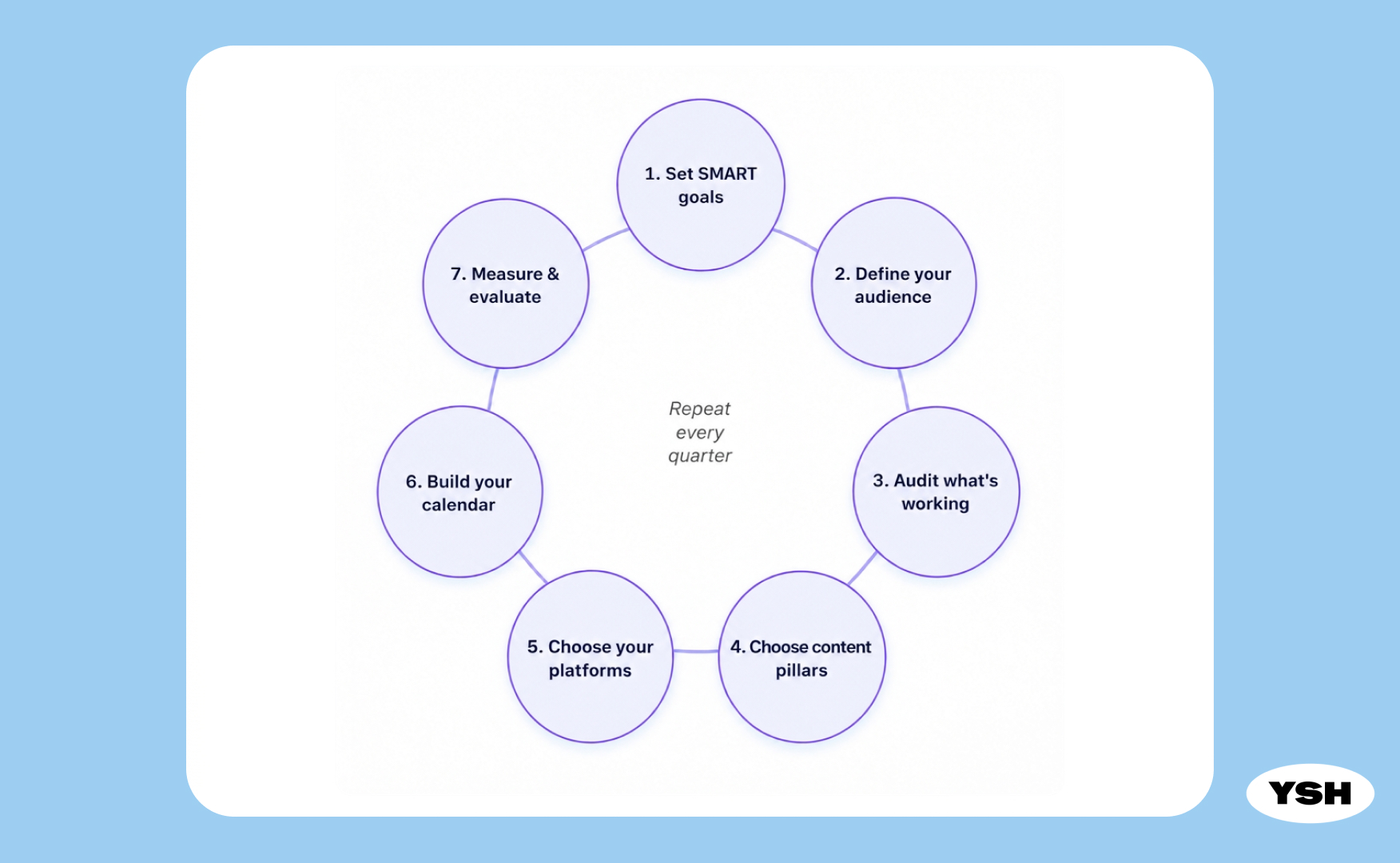
Start from your actual business goals, not "get more followers." Every goal should be specific, measurable, achievable, relevant, and time-bound.
A goal without a number and a deadline attached is a wish, not a strategy. Most social strategies need a full quarter to show real signal, so resist the urge to declare something "not working" after two weeks.
2. Define your audience
You can't choose platforms, formats, or content pillars until you know who you're actually talking to.
Ask who they are, what problem you can help them solve, where they actually spend time online, when they're looking for the kind of content you make, and how they prefer to consume it.
3. Audit what's already working
Before creating anything new, look at what you already have. A social media audit surfaces your highest-performing content types, your best posting windows, and where your audience growth is actually coming from.
If you're starting from zero, audit a small set of competitors instead.
4. Choose your content pillars
Content pillars are the 3 to 5 recurring themes your brand returns to again and again. They're what stop you from reinventing your content plan from scratch every single week, and they're what make a feed feel coherent instead of random.
A workable set of pillars for a B2B software company might look like:
- Product education (how-tos, feature explainers)
- Industry commentary (trends, platform or market shifts)
- Customer stories and case studies
- Team and culture (behind-the-scenes, employee spotlights)
- Direct promotion (offers, demos, launches)
For a consumer brand, say an activewear company, pillars might instead be workout tips, customer transformation stories, sustainability and brand values, community spotlights, and behind-the-scenes product development.
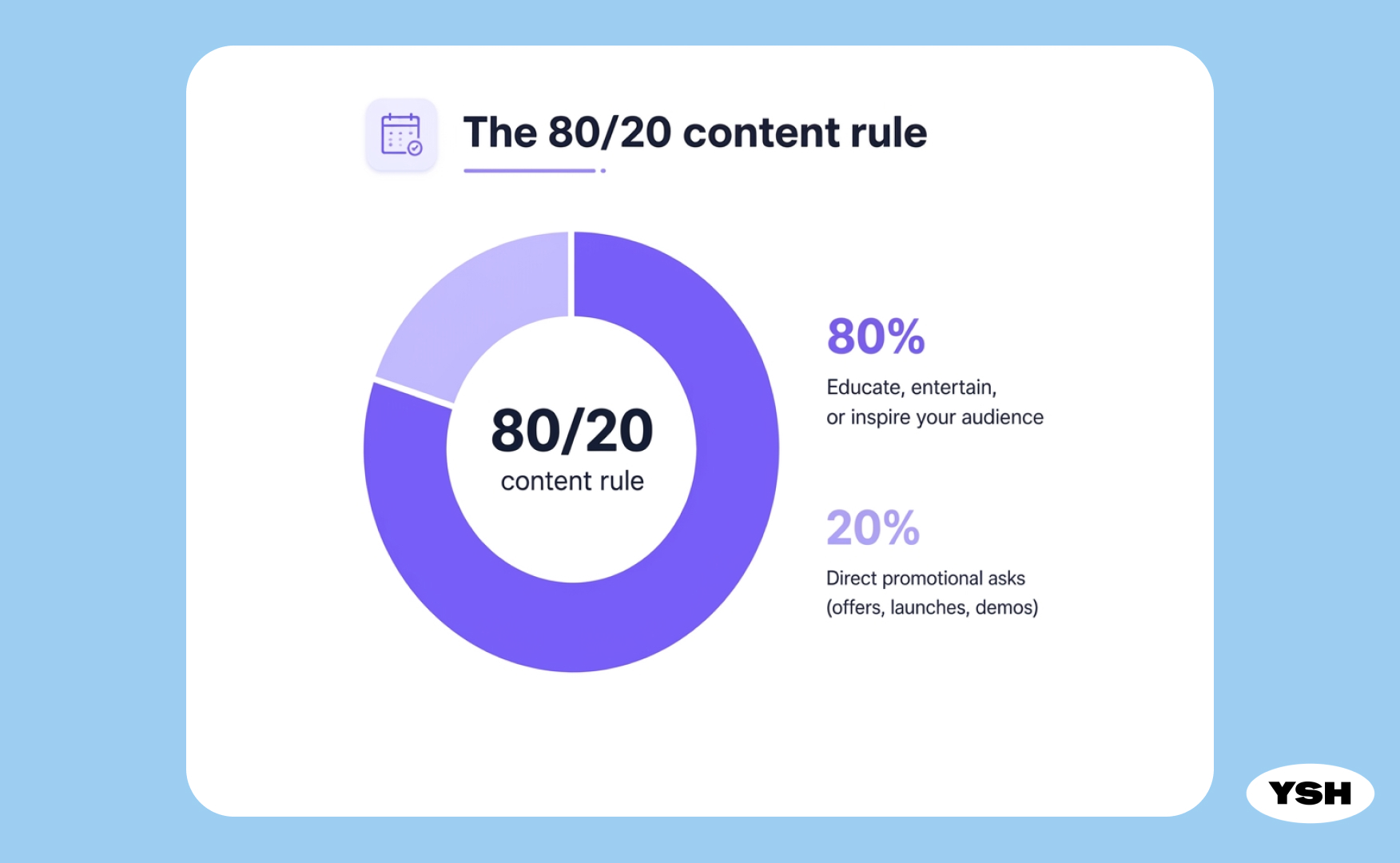
A useful ratio to apply across all of them: dedicate roughly 80% of your content to educating, entertaining, or inspiring your audience, and reserve about 20% for direct promotional asks.
Treat your team as a content pillar too. Posts shared by real employees tend to out-engage the same message posted from a company account.
5. Choose your platforms
Match your pillars and formats to wherever your audience actually is, not to every platform that exists.
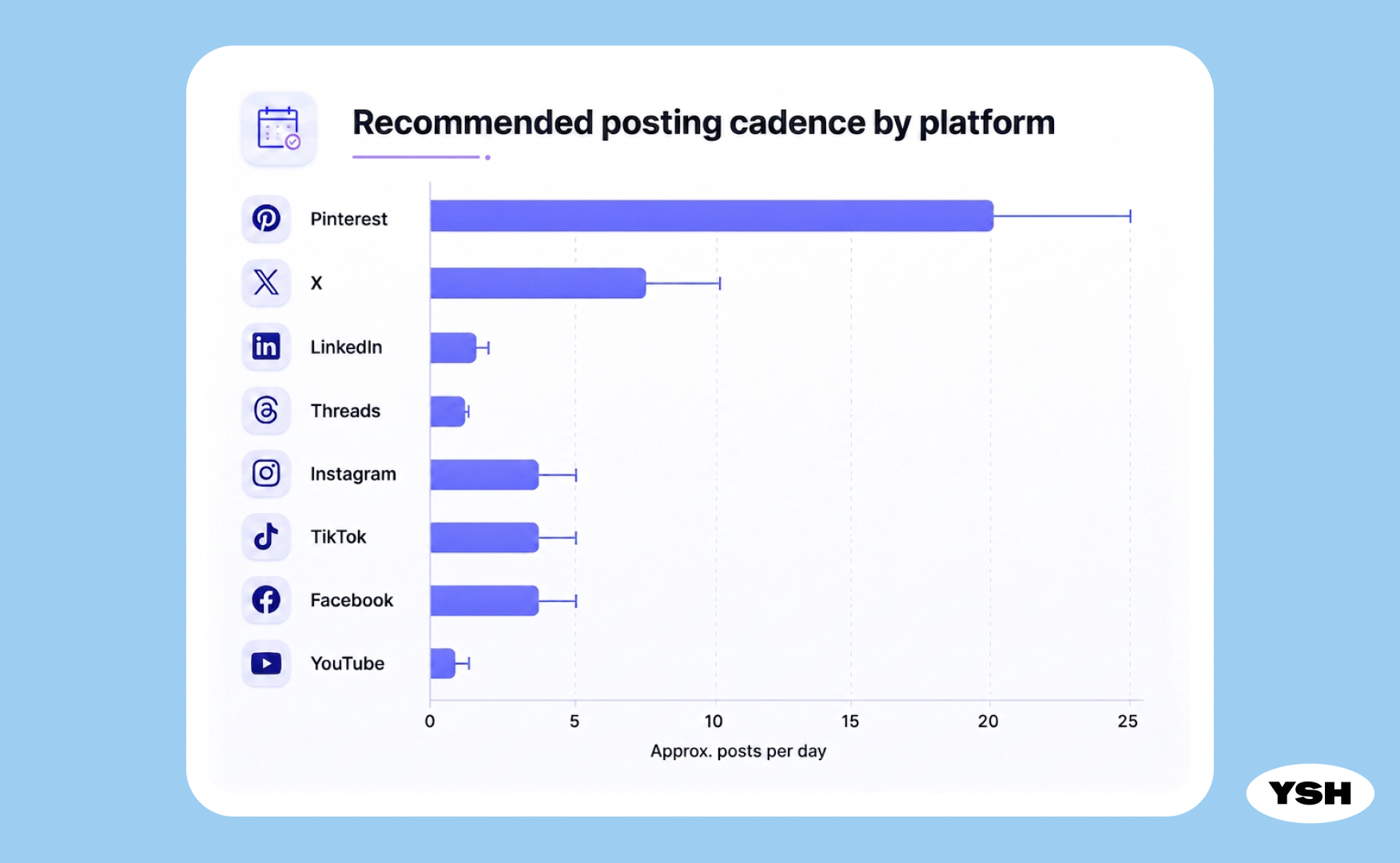
Don't try to be everywhere at once. Businesses that focus on two or three platforms consistently out-engage those spreading themselves across five or more.
| Platform | Best for | Standout content format | Typical posting cadence |
|---|---|---|---|
| Visual brands, product discovery, broad age range | Carousels (engagement), Reels (reach) | 3-5x/week feed plus daily Stories | |
| TikTok | Entertainment-led brands, younger audiences | Short-form video | 3-5x/week |
| B2B, thought leadership, personal branding | Document carousels, text posts | About once a day for consistent reach | |
| Broad reach, community groups | Images, short video | 3-5x/week | |
| YouTube | Long-form authority content, searchable how-tos | Long-form video plus Shorts | Weekly long-form, more for Shorts |
| Home, fashion, food, DIY, high purchase intent | Video pins | High volume, 15-25 pins/day for active accounts | |
| X | Real-time commentary, customer service, industry chatter | Text | Multiple times a day |
| Threads | Conversational, community-first brands | Mixed text/visual | About once a day |
| Bluesky and Mastodon | Niche, decentralized, community-led audiences | Video (Bluesky), consistent across formats (Mastodon) | As-needed, participation-first |
Carousels still outperform single static images on Instagram and LinkedIn for engagement, even as short-form video continues to win on reach. These serve different jobs, so many brands run both.
TikTok is the platform marketers say they plan to invest more in than any other heading into 2027, even as Instagram and Facebook remain the two most widely used platforms overall.
6. Build your content calendar
Turn pillars into a real, dated calendar.
Batch your planning 2 to 4 weeks ahead so your team isn't scrambling for ideas the morning of a post. Batch content creation in dedicated sessions rather than daily one-offs. This consistently improves both consistency and quality, and it opens the door to repurposing one piece of content into five formats.
 Map key launches and dates first, so product news and announcements get priority over routine content on those days.
Publish, then engage in the first hour. Actively responding to comments in the window right after you post is one of the highest-leverage things you can do for that post's reach.
7. Measure, then evaluate the whole strategy
Analyze monthly, pivot quarterly. Ask honestly: is this strategy moving the business goal from step one, or just growing engagement in isolation?
If followers and likes are up but sign-ups or sales aren't, that's a signal to revisit your audience definition or content pillars, not to simply post more.
Track reach, engagement rate, click-through rate, conversion rate, and how consistently you're replying, not just raw follower growth. Use UTM parameters on any link you post so traffic and conversions can be attributed back to the specific post and platform that drove them.
Social SEO: making your content searchable
 One of the bigger shifts going into 2027 is that posting isn't enough on its own. Content needs to be findable inside each platform's own search, not just discoverable through the algorithm's feed.
Write captions and video hooks that include the actual words your audience would type into that platform's search bar, not just clever copy. Use on-screen text and spoken keywords in video, since many platforms index audio and captions for search. Treat evergreen how-to content as a long-term search asset, not a one-time post.
Social listening and engagement
The single biggest driver of post performance often isn't when or how often you post. It's whether you actually respond when people talk to you.
A large share of consumers say they'll switch to a competitor if a brand doesn't respond on social media, which makes this less of a nice-to-have and more of a retention lever.
Reply to comments in the first hour after publishing. Track brand mentions even when you aren't tagged directly. Turn recurring questions or strong replies into new content ideas, closing the loop between listening and planning.
Common challenges, and how to fix them
Marketers consistently name the same handful of obstacles.
"We can't produce enough good content" is a systems problem, not a talent problem. Batching production and repurposing one asset into five formats fixes more of this than hiring more writers does.
"We can't stand out in a crowded feed" usually comes down to polish. Human, unpolished content is currently outperforming heavily produced content, so leaning into real voices, employees, founders, customers, is often the fastest fix.
"We don't know if it's working" usually traces back to step seven being skipped. If you haven't defined KPIs tied to a business goal, no amount of posting will feel like it's working.
"Approvals slow everything down" is especially common for agencies and in-house teams managing multiple stakeholders.
Get your Calendar ApprovedWhere the real bottleneck usually is
Once a strategy is documented, execution becomes a workflow problem: who creates the content, who approves it, and how it gets scheduled without anyone losing track of version history.
For a single in-house marketer, a simple content calendar and a scheduling tool are often enough.
For agencies and teams managing multiple brands or clients, the real bottleneck usually isn't ideas. It's the back-and-forth of getting drafts reviewed and signed off, especially when clients don't want, or shouldn't need, a full login to your tool.
Your Social Hub was built around exactly this problem. Clients review and approve content through a magic link, no account required, so nothing sits stuck in an inbox waiting on a password reset. Content calendars, ideas, drafts, feedback, and approvals all live in one shared workspace instead of being scattered across documents, spreadsheets, and email threads.
Whatever tool you choose, look for three things: a shared calendar view your whole team can see, an approval workflow that doesn't create extra login friction, and analytics that tie back to the KPIs you actually defined in step one.
8 practical tips for 2027
- Know your audience's actual pain points, not vanity metrics or fleeting trends.
- Focus on one or two platforms before trying to be everywhere.
- Fully optimize your profiles. For many prospects, this is their first real impression of your brand.
- Engage in your community, not just on your own posts.
- Be authentic. Real and slightly imperfect is currently outperforming polished and produced.
- Give before you ask. Content that helps builds trust faster than content that sells.
- Involve your team. Real employee voices humanize a brand faster than a polished company account.
- Keep links out of captions where the platform buries them, and avoid stuffing multiple links into a single post.
FAQ
How do I create a social media marketing strategy? Start with SMART goals tied to a real business outcome, define your audience specifically, audit what's already working, pick 3 to 5 content pillars, choose two or three platforms where your audience actually is, build a dated content calendar, and set up measurement before you publish anything, not after.
What is a social media content pillar? A content pillar is one of a small number of recurring themes a brand consistently posts about, for example product education, customer stories, and behind-the-scenes content. Pillars keep a content calendar coherent and make it faster to plan.
How much should I budget for social media marketing? It depends on goals and whether paid promotion is included, but a workable starting split puts most of the budget toward content production and a scheduling tool, with a smaller flexible amount reserved for boosting proven top-performing posts.
How often should I post on social media? Cadence varies significantly by platform: roughly daily for LinkedIn and Threads, several times a week for Instagram, TikTok, and Facebook, weekly for long-form YouTube, and considerably higher volume for active Pinterest accounts. Consistency at a sustainable cadence beats sporadic high-volume bursts.
Is social media marketing actually worth it? For most brands, yes. A large majority of marketers report Facebook, Instagram, and LinkedIn as high-ROI channels, and short-form video and influencer partnerships are outperforming traditional digital ad formats for many businesses. Effectiveness depends heavily on having an actual strategy rather than ad-hoc posting.
Which platform is best for social media marketing? There isn't a universal answer. The best platform is wherever your specific audience already spends time and engages, not the platform with the largest total user base.
What's the difference between a social media strategy and a content calendar? The strategy is the why and who: goals, audience, pillars, platforms, and measurement. The content calendar is the what and when: the actual dated posts that execute the strategy.
Build the strategy, then let the workflow keep up with it
A good social media marketing strategy only works if the day-to-day execution can keep pace with it. That's usually where things fall apart, not in the planning, but in the back-and-forth of getting content made, reviewed, and out the door.
Start using Your Social Hub to bring your calendar, ideas, and approval workflow into one shared workspace.
Get Started